| Decision | Supported starting point | Planning use |
|---|---|---|
| Aperture for one person with a softer background | f/2.8 | Choose this when the subject is alone and you want the background to recede. |
| Aperture for groups, or more of the face in focus | f/4 to f/5.6, or smaller as required | Close down when a second face or the full face must stay usable. |
| Aperture for wide group shots | f/11 | Suits rows of people where sharpness across the frame matters more than separation. |
| Aperture for full-length portraits | Around f/8 | Keeps the whole body sharp rather than only the face. |
| Shutter speed for a relatively still subject | About 1/250 second, faster for movement | Use it as the default for posed portraits and raise it when the subject moves. |
| Shutter speed for children | Minimum 1/125 second, higher if they run | Treat it as a floor, not a target. |
| ISO | As low as the light allows | Raise it rather than accept a blurred portrait. |
| Focus | Eye nearest the camera, with eye-detection autofocus if supported | Place the focus point on the eye before checking anything else. |
These figures come from The School of Photography’s portrait tips and Photzy’s portrait settings guide.
The best camera settings for portraits start with aperture, then a shutter speed fast enough to avoid blur, then the lowest ISO the light allows, with focus on the eye nearest the camera.
Treat every value here as a starting point and adjust it to the light. If you are still learning how the three exposure controls interact, photography basics for beginners covers the groundwork.
Sample settings by portrait scenario
Sample settings save time because they give you a defensible first frame, but they are not fixed recipes. Photzy makes the point that there are no absolutes with camera settings, so the available light decides how far you move from each starting point.
- Sunny day outdoors: Rebecca Rice Photo starts at f/2.8, ISO 100 and a shutter speed of 1/200 second.
- Cloudy day outdoors: The same photographer keeps f/2.8 and 1/200 second but starts at ISO 400. Only the ISO changes from the sunny-day setup.
- Indoor natural light: The starting point is f/2.8, ISO 600 and 1/200 second, with the note that it is typically just darker inside.
- Outdoor headshots in bright sun: Photzy likes an aperture of around f/4 for headshots and suggests starting at 1/250 second, then going faster if the frame is overexposed.
- Children: Photzy says you need a minimum of 1/125 second to freeze kids, and more if they are running. Pair it with f/5.6 so a small change in distance does not lose the eyes.
- Groups and full-length frames: Start at f/11 for a wide group shot and around f/8 to keep a whole body sharp.
The sunny and cloudy examples differ only in ISO, and 1/200 second sits close to the 1/250 second suggested elsewhere. Either value is reasonable for a posed subject, so let movement decide: stay near 1/200 for a calm sitter and go faster for anyone fidgeting.
Aperture, lens choice and depth of field
Aperture is the first setting to fix because it controls how much of the portrait is sharp. Photzy puts it bluntly: in portraiture, the aperture is king, and it recommends setting it first because depth of field is crucial for this work. Rebecca Rice Photo also sets aperture first when working through aperture, ISO and shutter speed.
The usable range is wide. Live Snap Love describes portrait apertures anywhere from F1.4 to around F5.6, with F2.8 or F3.2 as a middle start. A wide setting suits a single subject and a clean background. A narrower one suits anything where several faces, or a full face, must stay in focus.
Choosing between wide and narrow
- Wide for one person: The School of Photography suggests f/2.8 for one person if you want a softer background.
- Narrower for groups: For groups, or when you want more of the face in focus, it suggests f/4 to f/5.6 or a smaller aperture as required.
- Check the whole frame: A very wide setting on a close face can leave the far ear soft, so step toward the narrower end if the face is the point of the portrait.
Lens and distance
Photzy prefers 50mm, 85mm or 135mm lenses for portraiture. For a head-and-shoulders frame, The School of Photography gives about 85mm on full frame, roughly 50-56mm on APS-C and 42.5mm on Micro Four Thirds as comparable starting points. It adds that camera-to-subject distance, rather than focal length alone, changes how facial features appear, so stepping back or forward is a perspective decision as well as a framing one.
Shutter speed and ISO without blur
Shutter speed protects sharpness, and ISO is the setting you give up first to keep it. Live Snap Love gives 1/125 second as the absolute minimum for a portrait and warns that higher focal lengths need a higher shutter speed.
Rebecca Rice Photo suggests doubling your focal length to set a minimum shutter speed, so a 50 mm lens should run no slower than 1/100. The School of Photography starts around 1/250 second for a relatively still subject and recommends a faster shutter speed for movement.
Letting ISO rise
The School of Photography advises keeping ISO as low as the available light allows, but raising it rather than risking a blurred portrait. Rebecca Rice Photo observes that grain often appears in the 1200 range.
Underexposing to avoid raising ISO tends to backfire, because Live Snap Love notes that underexposure makes noise worse. If the frame is dark, raise ISO instead of leaving it dim.
Why manual mode helps
In manual mode you decide all three exposure settings yourself, as Live Snap Love explains. That is useful in portraits because you can fix aperture for the look, fix shutter speed for sharpness and let ISO absorb the changes in light.
Autofocus and eye tracking
Eye-detection autofocus is the first choice when your camera has it, and a single point placed on the eye is the dependable fallback. The School of Photography says to focus on the eye nearest the camera, using eye-detection autofocus if your camera supports it.
Photzy recommends a single-point autofocus area so you can direct the camera precisely where to focus, then extending to a group of points when you are photographing groups. The first mode suits a posed portrait at a wide aperture, where a small focus error is visible in the eyes. The second suits several people, where one precise point would miss someone.
Use that pairing as the rule of thumb: precise point or eye tracking for one face, a wider area for several faces. A wide aperture leaves little room for error, so check the eye, not the nose or ear, before trusting the frame.
When to move away from the sample settings
Light, lens choice, subject movement and the amount of background blur you want all shift the right settings, because The School of Photography notes that no single set of camera settings works for every portrait. Treat the table at the top as a sorting tool: find the nearest scenario, then change the one setting the scene demands.
- Subject starts moving: Raise the shutter speed first, then lift ISO to restore exposure.
- Background is distracting: Widen the aperture toward the range given earlier, or change your distance from the subject.
- More people join the frame: Close the aperture and widen the autofocus area.
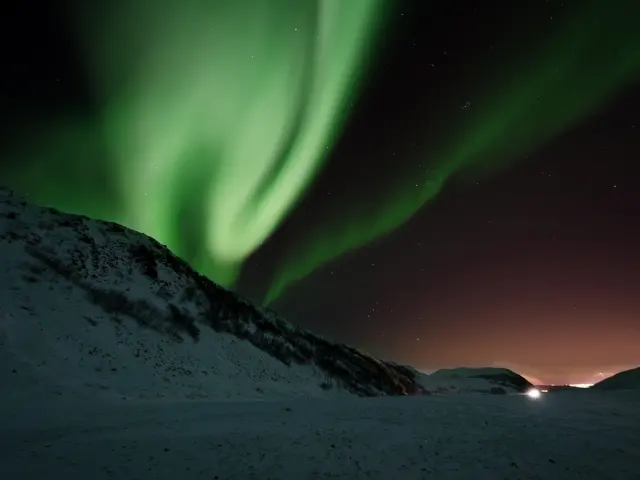
Portraits made at the edge of the day need their own exposure thinking. The exposure approach in Camera Settings for Stunning Sunsets: Simple Rules and Settings for 2026 is a useful companion when the light is low and changing, and Capture The Northern Lights: A Practical Guide To Camera Settings That Work In 2026 shows how settings are handled when light is scarce.
Frequently asked questions
What aperture is best for portraits?
For one person with a softer background, try f/2.8, according to The School of Photography. Move to f/4-f/5.6 or smaller for groups.
Which autofocus mode should I use?
Use eye-detection autofocus if your camera supports it, and otherwise a single autofocus point on the eye nearest the camera. For groups, Photzy suggests widening to a group of points.
What shutter speed avoids blur?
The absolute minimum for a portrait is 1/125, according to Live Snap Love, and The School of Photography starts around 1/250 second for a relatively still subject. Go faster for movement or longer lenses.
Should I shoot portraits in manual mode?
Manual mode lets you decide aperture, shutter speed and ISO together. That control is useful when you want a fixed depth of field and a safe shutter speed while the light changes.